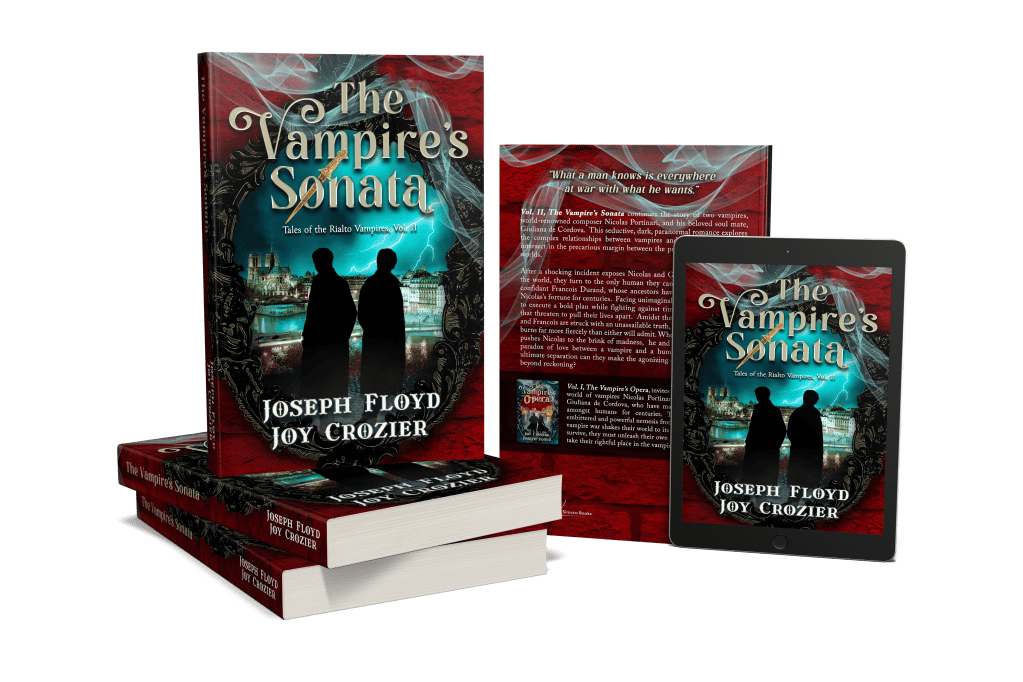
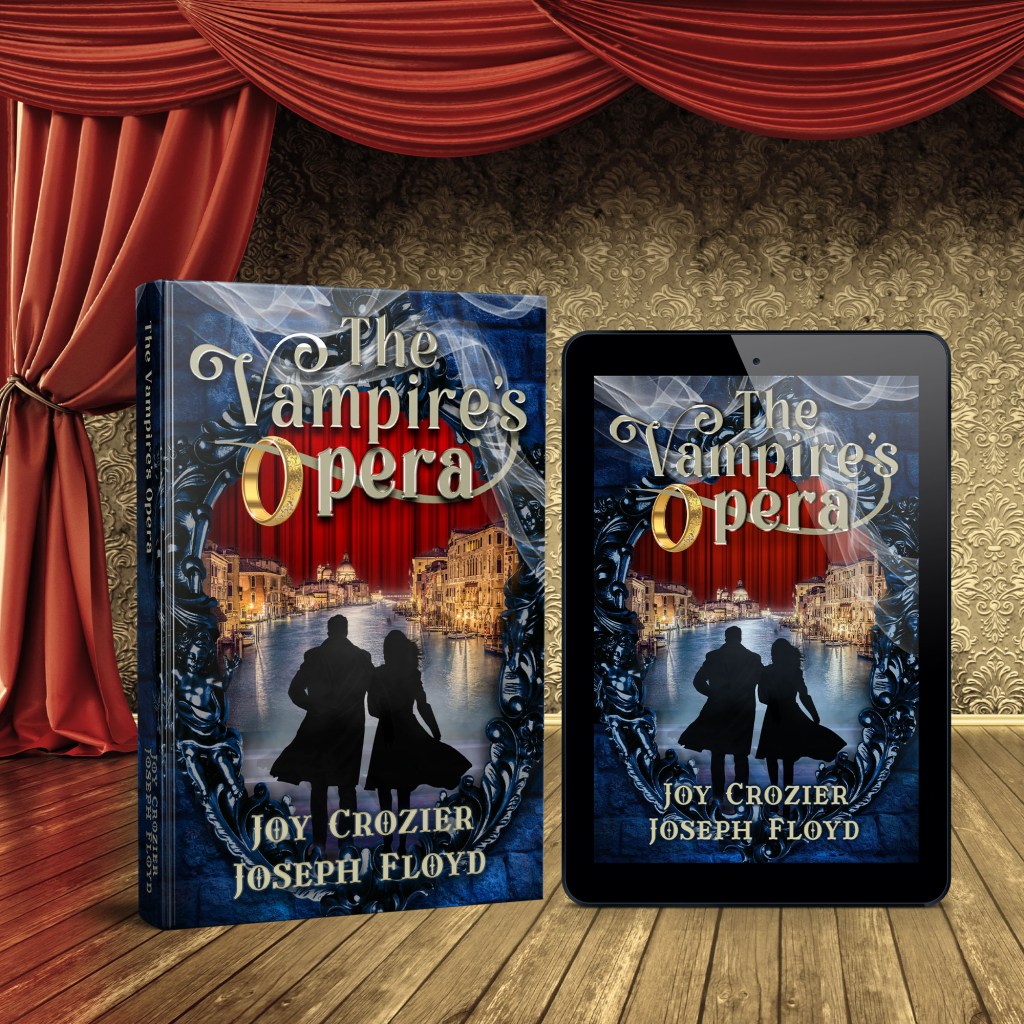
This past spring, we released “The Vampire’s Sonata,” the long awaited sequel to “The Vampire’s Opera.”
We asked ChatGPT AI about “The Vampire’s Opera” and here is what it had to say:
“Yes, I would recommend The Vampire’s Sonata by Joy Crozier and Joseph Floyd—especially if you’re a fan of gothic romance, LGBTQ+ paranormal fiction, or emotionally rich vampire stories.
What It’s About
The Vampire’s Sonata is the second book in the Tales of the Rialto Vampires series, following The Vampire’s Opera. It continues the story of Nicolas Portinari, a centuries-old vampire and composer, and François Durand, his human confidant. Set against the haunting backdrop of Venice, the novel delves into their deepening bond as they confront external threats and internal conflicts. As François’s life hangs in the balance, both characters must face the painful truth of their connection and the choices that come with it.
Why It Stands Out
Reviewers have praised the novel for its lyrical prose and emotional depth. The collaboration between Crozier and Floyd is noted for its seamless narrative voice, creating a romance steeped in elegance and longing. The story balances romantic moments with action-packed supernatural scenes, making it a compelling read for fans of the genre.
The novel also explores themes of identity and personal discovery, presenting LGBTQ+ characters whose sexuality is an integral part of their identity without overshadowing the narrative. This balance contributes to its standing as a notable work in LGBTQ+ paranormal fiction.
Final Verdict
If you’re drawn to stories that intertwine passion and peril, set in evocative locations like Venice, and appreciate richly developed characters facing moral and emotional dilemmas, The Vampire’s Sonata is a worthwhile read. It’s especially recommended for readers who enjoy gothic romance with a modern, inclusive twist.
You can find The Vampire’s Sonata on Amazon in Kindle and paperback formats. “
Who are we to argue with ChatGPT? 🙂
As noted, you can find The Vampire’s Sonata on Amazon in Kindle and paperback formats. Click Here to BUY NOW.
The fabulous architecture, the romantic lagoon, the glorious light and the sense of timelessness that surrounds it make Venice an ideal movie location. Movies set in Venice are tricky because while beautiful, the cities’ tight spaces, water and boats are not friendly to camera equipment. That said dozens of movies have been filmed there through the years. These are some of my favorites.
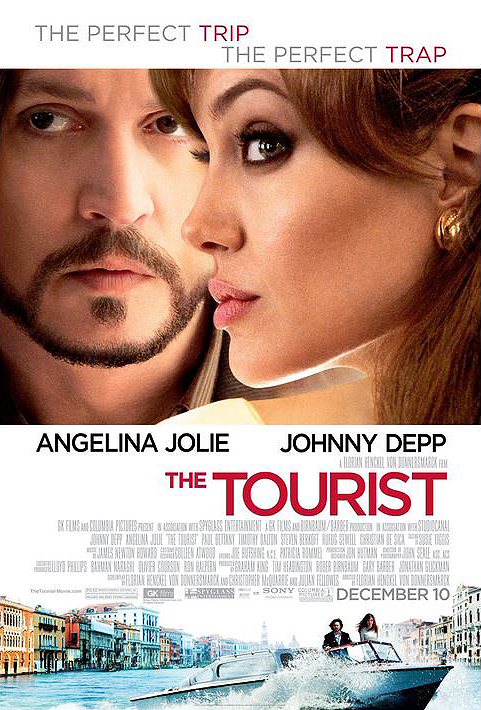
1 The Tourist (2010) Director: Florian Henckel von Donnersmarck, Run time: 103m
While not a critical success, this whole film is a journey through the city. The plot is a mess but the cinematography is gorgeous. Watch it with the sound off for a beautiful travelogue of Venice. Angelina Jolie & Johnny Depp star as two strangers, one of whom is a math teacher, the other is an undercover agent from Scotland Yard. Among the locations featured are the Palazzo Pisani Moretta with its’ Venetian Gothic flora façade (which stands in for the Hotel Danieli); the Fondaco dei Turchi,( a 9th Century Byzantine palazzo on the Grand Canal featured in a Ball scene):the interior of the Scuola Vecchia della Misericordia (interior shots of the ball); the Arsenal (stands in as the location of Interpol headquarters):and many more including the Palazzo Venier dei Leoni aka the Peggy Guggenheim Collection, Piazza San Marco and Giudecca Island.
2 Casino Royale (2006) Director: Martin Campbell, Run time: 144m
Bond film #21 stars Daniel Craig and rebooted the series. It features lots of beautiful globe hopping locales but the climax of the film takes place in Venice. This movie depicts James Bonds’ 1st mission as 007. His mission is to defeat a terrorist funding banker in a high stakes poker game at Casino Royale in Montenegro. Needless to say, things don’t go smoothly and, after the mission, Bond convalesces in Venice. Daniel Craig and Eva Green cruise the Grand Canal in a sailing yacht (something which required special permission as it hadn’t been done in 300 years). One of the best scenes takes place in the Palazzo Pisani, which, seemingly, (spoiler alert) collapses and sinks into the sea! It’s a breathtaking scene and one that leaves you wondering “Did they really do that?” (No palazzos were harmed in the making of this movie.) Among the other locations featured are St. Mark’s Square, the Grand Canal, The Accademia and Rialto bridges, and the Santa Maria della Salute.
3 Summertime (1955) Director: David Lean, Run time: 100m
Starring Katherine Hepburn and Rossano Brazzi. Summertime is the story of an unmarried secretary from Ohio who goes on her dream trip to Venice and has a brief but passionate romance with a Venetian shop owner. Most of the film was done in and around St. Mark’s Square and the Campo San Barnaba where Brazzis’ fictional antique shop was located. Kate stays at the Pensione Fiorini (which is now the Splendid Hotel. She visits all the famous places including the islands of Murano and Burano. It’s a beautiful portrayal of the city as seen through the eyes of a tourist. During the filming, Kate had to fall into the Grand Canal by the Church of St. Barnaba for multiple takes, (something she insisted on doing herself). As a result, she caught an eye infection that lasted the rest of her life. See Venice, but stay outta the water!
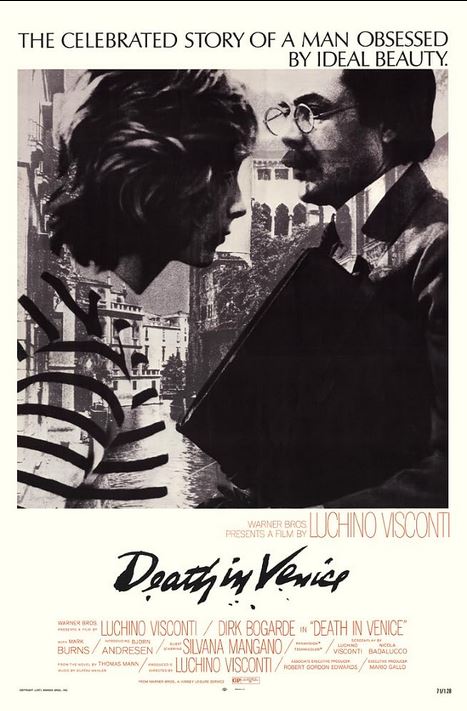
4 Death in Venice (1971) Director: Luchino Visconti, Run time: 130m
Based on the Thomas Mann novel of the same name. This movie stars Dirk Bogarde. Set in the 1800s, it is the story of a dying composer who goes to Venice to convalesce. While there he becomes obsessed with a young teenage boy staying at his hotel. It’s been described as “a lush, emotional cinematic wallow, with a soundtrack by Gustav Mahler.” Except for a few interior scenes, it was filmed almost entirely in Venice. Among the locations featured are the maze of small canal side paths behind the Teatro La Fenice opera house, St. Marks Square, the beach at the Lido and the Grand Hotel des Bains on the Lido.
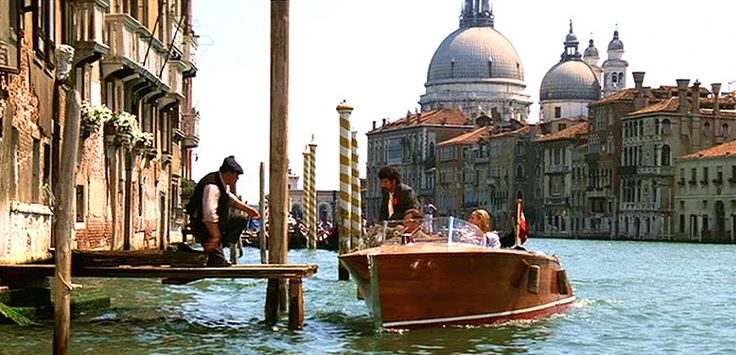
5. Indiana Jones and the Last Crusade (1989) Director: Steven Spielberg, Run time: 128m
The third Indiana Jones movie contains one of my favorite scenes filmed in Venice. Like the 007 films, the Indiana Jones movies are famous for their globe-trotting settings. While most of this movie was filmed on soundstages in England, they did actually film in Venice too. One of this films highlights is a thrilling motorboat chase through Venice’s’ Grand Canal. It’s considered one of the best chase sequences in the entire Indiana Jones franchise. The Campo San Barnaba and the Church of St. Barnaba are stand-ins for the library Indiana visits to search for clues to the location of his missing father. The church is a plain building built in the 18th century with one of the oldest bell towers in the city. It’s no longer used as a church but instead contains various exhibits. Other locations featured in the movie include: Ponte dei Pugni Bridge, and the Fondamenta Alberti which is one of the longest canal side streets in Venice.
6. The Wings of the Dove (1997) Director: Iain Softley, Run time: 102m
This movie is based on the novel of the same name by Henry James. Helene Bonham Carter stars as a broke English woman living in Venice with her aunt. Circumstances force her to choose between a privileged life with her wealthy aunt and a poor life with her journalist lover. She befriends a dying American heiress who is attracted to her (Helene’s) own lover. She hatches a plan to have both the privileged life and the lover she can’t live without. The city becomes a character in the film, dazzles with its’ beauty. Its’ gondolas, palazzi are portrayed in lush period style as a backdrop to the story. The movies sober London locations are contrasted with Venice’s’ brilliant locales. Locations featured include St. Mark’s Square, St. Mark’s Basilica, Palazzo dei Camerlenghi, the magnificent Santa Maria della Saute, and the Palazzo Barbaro (where, incidently, Henry James wrote the original novel).
7. Casanova (2005)Director: Lasse Hallström, Run time: 112m
Casanova is synonymous with Venice. In this movie, Heath Ledger stars as Giacomo Casanova, a notorious womanizer who is facing expulsion from Venice by the Doge for crimes against morality…unless he gets married. The problem is, the woman he falls in love with seems impervious to his charms. In a movie filled with mistaken identities, there’s no doubt who the real star is, Venice in all its magnificent splendor. This movie is one of the rare films shot entirely in Venice and it is truly is a love story to the city. It’s a portrayal of Venice as we like to imagine her in all her glory in the late 1700s. From the grandeur of the interiors in the Doges’ Palace, to the visual feast and sumptuousness of a Venetian Carnevale, this movie recreates the look and feel one imagines when one thinks of Venice. Featured locations are too numerous to list but highlights include a recreation of the famous Venetian Carnevale in St. Marks Square, a night-time hot air balloon ride over the city (CGI but who cares), interiors of the gothic Palazzo Soranzo Van Axel which dates from the 1470s, the Grand Canal, St. Marks Square, a dazzling l masked ball was filmed in the Scuola di San Rocco, The Doge’s Palace, the magnificent façade of Santa Maria della Salute, and the Palazzetto Pisani.
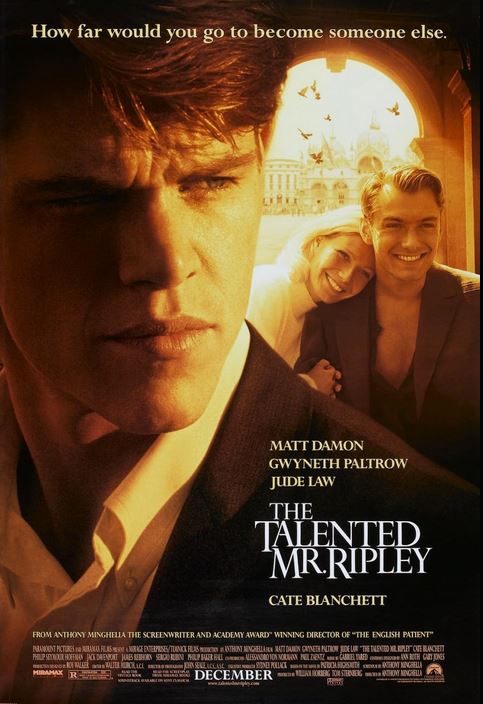
8. The Talented Mr. Ripley (1999) Director: Anthony Minghella, Run time: 139m
Based on Patricia Highsmiths’ novel of the same name, this movie stars Matt Damon as Tom Ripley, with Jude Law, Gwyneth Paltrow and Cate Blanchette. In the late 1950s Tom Ripley, a scheming young man who thinks it’s better to be a fake somebody than a real nobody, is hired by the parents of a rich spoiled playboy, Dicky Greenleaf, to convince him to return to the U.S. from Italy. Ripley worms his way into the lives of Dicky and his girlfriend but things don’t go quite as planned. A case of mistaken identity escalates into a web of lies and ends in murder. Portions of the movie take place in Venice. The Café Florian on St. Marks Square, the Calle Traghetto Vecchio and the basilica Santa Maria della Salute are all featured in scenes.
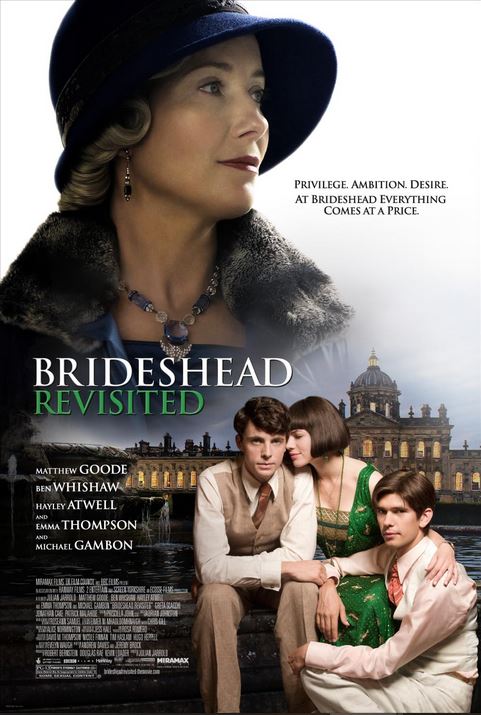
9. Brideshead Revisited (2008) Director: Julian Jarrold, Run Time: 133M
This film is an adaptation of the novel of the same name by Evelyn Waugh. Matthew Goode stars as Charles Ryder, a man who befriends the wealthy British Lord Sebastian Flyte (played by Ben Whishaw) and becomes wrapped up in his life and family. They travel to Venice early in the film and stay at Sebastians’ Venetian palace which is actually the Palazzo Contarini Polignac, a late 15th century Palazzo right on the Grand Canal. In the early 1900s, this palazzo belonged to the daughter of Isaac Singer (the founder of the Singer Sewing Machine Company) and was the site of a great artistic and intellectual salon which hosted many famous musicians and artists. Today the palazzo is a private residence. While only a portion of the movie is set in Venice it’s worth seeing. Featured locations include the canal and square of the Church of the Holy Apostles, a 7th century Catholic church (one of the oldest in the city), and the Basilica of Zanipolo, (one of the largest churches in the city and built in the late 1300s-1400s).
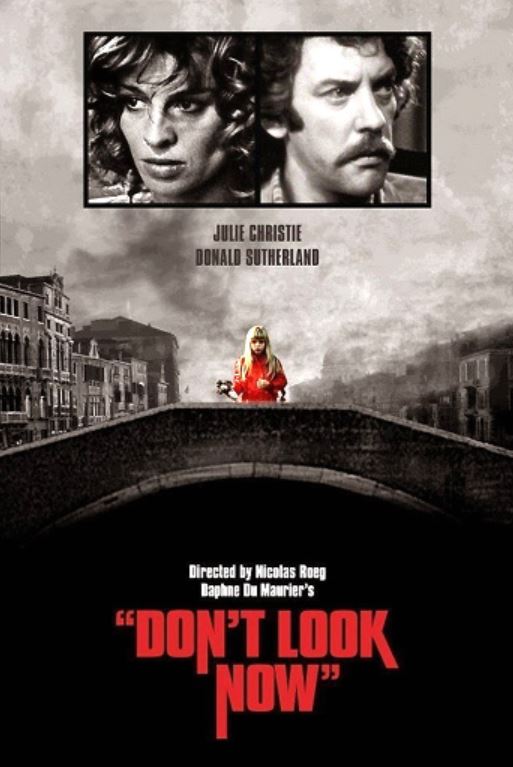
10. Don’t Look Now (1973) Directory: Nicolas Roeg, Run Time: 110M
Adapted from a short story by Daphne du Maurier, this is a thriller starring Julie Christie & Donald Sutherland. They portray a married couple who travel to Venice after the accidental death of their daughter. He’s there to renovate one of the cities old churches. If you can’t stand dreamy, romantic, travel films and love a good thriller, this one is probably for you. Venice in this film is dark and crumbling. Locations include; the Hotel Gabrielli (a Gothic palazzo overlooking St Mark’s Basin waterfront); the Church of St. Nicholas of the Beggars (one of the oldest churches in the city, dating from the 12th Century); and the interiors of the magnificent Palazzo Grimani di Santa Maria Formosa.
Music has always been a touchstone for me when I write. Musicians have always known that it can cast a spell, set a mood or express an emotion. As a writer, I’ve found that it can also describe an action, or, perfectly capture a characters’ thoughts. It can trace the tempo of a dialog or better evoke the underlying motivation of a character that I’ve been trying to capture in words. You can read books on how to plot or shape a character, but nothing can provide better access to delineating the subliminal, emotional life of your characters as music can. I don’t always write to music, but, I always write better when I do. Music allows me to connect better with a character or a setting. This may say more about me than it does about the connection between writing and music but that’s the subject for a different post.
I’ve found that the music that works best while I’m writing is invariably either classical or movie soundtracks. I tend to listen to movie soundtracks most because they are designed to put you in a particular frame of mind, or emotion. Soundtrack music illuminates a character or scene. It provides a thematic, emotional shortcut which can set your writing in motion, stimulate your imagination and help break through blocks you might have.
I have just one rule about my writing music. It can’t have words (at least not in English). For me words just confuse the process. I’m trying to find MY words, not hear someone else’s’. Humming, chanting or even wordless choirs are fine. I’ve even been known to write to whale song, That said, these are a few pieces I listened to while working on the Vampire’s Opera.
DISCLAIMER: I don’t own the rights to this music. No copyright infringement intended! Copyrights belong to the original owner(s). Music/Images/Videos posted are for entertainment purposes only!
1) IIia’s Theme from The Original Soundtrack to Star Trek The Motion Picture Yes, music from a Star Trek movie, and one which many label the worst of them all. However, the music is another story. The music is considered composer Jerry Goldsmiths greatest film score. With a career that spanned half a century and hundreds of soundtracks, that’s quite the accolade. The soundtrack to this movie went on to be nominated for both an Academy Award and a Golden Globe and was among the 250 nominated by the American Film Institute for consideration for their list of the top 25 American Film scores of all time. This piece, Ilia’s Theme, immediately evoked Giuliana for me. If Maestro Portinari ever wrote music for her, this is what it would sound like. It’s tender, ethereal even. The strings and solo piano weave around one another, point and counterpoint, perfectly capturing both her beauty and her strength. https://www.youtube.com/watch?v=Mj4z2Y1y2Ak
2) Adagio of Spartacus & Phrygia from Spartacus by Aram Khachaturian. One of Khachaturian’s’ most famous works, the adagio is from his ballet, Spartacus. It’s literally music for a dance by two lovers and seemed a perfect piece to embody the relationship of the two main characters of the Vampire’s Opera. They are each other’s yin and yang. Strong individuals on their own, they are more together. The melody from the upper strings is replied to with a countermelody by the lower strings in a delicate pizzicato. The two sections, like our two characters, wind round one another and weave through the piece to climax in a deeply romantic love theme. The music completely captured for me, the tenderness, passion and strength of Nicolas & Giuliana. https://www.youtube.com/watch?v=LZLMKkEGFRo
3) Concerto #8, Moderato by Alan Hovhaness This concerto is generally regarded as one of composer, Alan Hovhaness’ strongest works. For me, its’ second movement perfectly captures the mood of isolation and sense of aloneness that our character Giuliana felt during her first sojourn in Egypt. She had arrived there as an exile and found herself isolated in an oasis in the heart of a desert, El-Samun, the home of Nicolas Portinari. At night, she wanders the gardens of the palace. It’s there where she first meets Nicolas. He visits her during her nightly excursions and gradually, their relationship develops and they soon fall in love. This piece captures both her sense of isolation as well as the intriguing hint of discovery she makes there. (Starts at 6:59 marker on this video): https://www.youtube.com/watch?v=bNzTxrTwixw
4) Love Remembered from OST to Dracula by Wojciech Kilars From Polish composer Wojciech Kilars’ soundtrack to Bram Stokers’ Dracula. Yes, a love theme because this is where Nicolas & Giuliana fell in love. The music lends itself to nighttime desert vistas of stars and dunes that also reflects a yearning for something, someone, that’s missing. Love Remembered is a song of both longing, and, of the recognition of what one has been missing. The delicate melody drifts through the piece in the voice of a lone flute against a gossamer web of descending strings. In harmony, they echo and weave around one another quietly, insistently. The music drifts quietly downward to its’ conclusion as Nicolas and Giuliana fall irredeemably in love. https://www.youtube.com/watch?v=OM9KdvA7D7E
5) Clive & Ann from the OST to Maurice by Richard Robbins. I imagined this piece as an excerpt from Nicolas’ Sonata for Francois, a musical piece which becomes a prominent theme in our next book. Woodwinds and a solo piano pick out a melody which traces the outlines of an unrequited love. The piece ends without a concluding chord, leaving the end, like the relationship, unresolved. For now. https://www.youtube.com/watch?v=EEQbBzFugBo
6) Surprise attack from the OST to Star Trek 2 by James Horner. On this, his first soundtrack for the Star Trek series Horner took the series musically, into a more emotional realm. I used this music when writing the events that take place at climatic point in the Vampire’s Opera, the explosion at the Portinari Building in Paris. The percussion and plucked strings count down the moment to the explosion, like a time bomb. Menacing horns and strings weave into a sinister melody that perfectly conjures up the suspense of the moment. There’s a lot of quiet in this piece but it was the louder, more dynamic sections that helped capture the scene. https://www.youtube.com/watch?v=Feb8TnbvyG0
7) Transformation-Seduction from the OST to Cat People by Giorgio Moroder. Sometimes an object, a piece of equipment or furniture takes on a life of its own and becomes a symbol of something bigger and more important. This was the case for the Clepsydra at El Samun, an ancient water clock designed to make the many fountains at Nicolas’ villa erupt synchronously into geysers at the stroke of midnight. At first the nightly occurrence marks the end of another empty day of exile for Giuliana. Eventually though, the cascade of fountains becomes the signal for the arrival of Nicolas. This piece with its’ pulses of synthesizer wrapped in a nocturnal atmosphere, captures both the sound of the fountains and the mood of expectation I envisioned while writing thesescenes. https://www.youtube.com/watch?v=RVdGkKy0r90
8) Main Titles from the OST to Emily Bronte’s’ Wuthering Heights by Ryuichi Sakamoto. Every great character deserves a great theme and Maestro Portinari’s is served up in the form of the main theme to this 1992 soundtrack by Ryuichi Sakamoto. Nicolas is a paradox. He is a vampire who longs for his lost humanity and is driven to maintain his connection to the human world. He, like this music, shifts between obsession and intensity, between tenderness and malevolence. From the first quavering notes of the flute in the opening to the final muted glissando of the strings, we are allowed to glimpse his darkness and his light and above all his humanity. https://www.youtube.com/watch?v=1oUcmForp_E&list=RD1oUcmForp_E&start_radio=1




 Sirocco Books